

Most small business owners did not start their company to spend evenings reconciling bank statements. And yet, that is exactly where a lot of them end up, especially in the early years when budgets are tight and hiring a full-time bookkeeper feels out of reach.
The thing is, the cost of doing your own books poorly often exceeds what outsourced bookkeeping actually costs. Missed deductions, IRS notices, and cash flow surprises are common consequences of disorganized records. This guide breaks down what outsourced bookkeeping actually includes, what you can expect to pay, and how to decide whether it is the right move for your Atlanta or Alpharetta business.
The Real Cost of Handling Your Own Books
Time is the first cost. Business owners who handle their own bookkeeping typically spend somewhere between 5 and 15 hours per month on it, depending on transaction volume. That time has real value, especially when it comes out of hours you could be spending with clients or working on your actual business.
The second cost is accuracy. Bookkeeping errors tend to compound. A miscategorized expense in January can throw off your reports for the rest of the year, create problems at tax time, and trigger questions from the IRS if you are ever audited.
The third cost, which is harder to quantify, is visibility. If your records are a month or two behind, you are making financial decisions without accurate information. You might think you are profitable when cash is actually tighter than you realize.
What Outsourced Bookkeeping Actually Covers
When people hear “outsourced bookkeeping,” they sometimes picture someone entering transactions into a spreadsheet. In practice, the scope is wider than that.
A professional bookkeeping service typically handles:
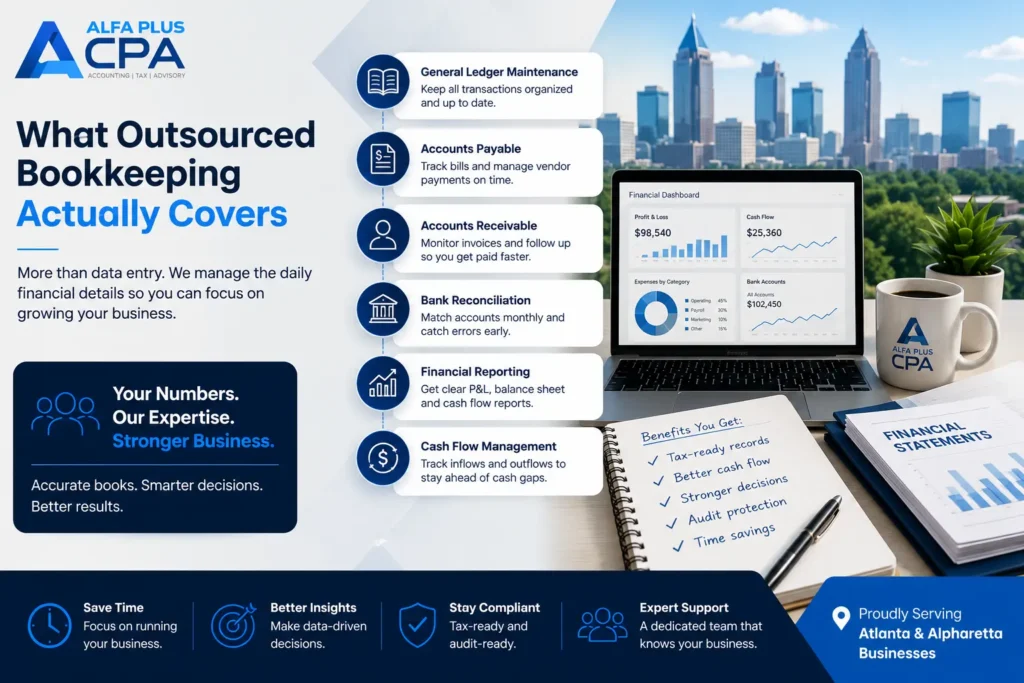
- General ledger maintenance: Keeping the master record of all financial transactions organized and up to date throughout the year.
- Accounts payable: Tracking what your business owes vendors and when payments are due, so nothing slips through.
- Accounts receivable: Recording what clients owe you and following up on late invoices before they become a problem.
- Bank reconciliation: Matching your records to your bank statements monthly so errors get caught quickly, not at the end of the year.
- Financial statement preparation: Producing profit and loss statements, balance sheets, and cash flow reports on a regular schedule so you always know where the business stands.
- Cash flow management: Monitoring inflows and outflows to flag potential shortfalls before they create a crisis.
Some services, including Alfa Plus CPA’s accounting and bookkeeping services, also integrate payroll processing, sales tax tracking, and tax preparation into the same workflow. That reduces the back and forth at filing time significantly.
Benefits That Go Beyond Saving Time
The time savings are real, but they are not the whole picture. There are a few other advantages worth considering.
Tax-ready records year-round: When your books are maintained consistently, tax filing is not a scramble. Your CPA already has the organized data needed to file accurately and identify deductions. There is a real difference between handing your accountant a box of receipts in April and handing them a set of reconciled statements.
Better access to financing: Banks and lenders ask for financial statements when you apply for a loan or line of credit. If you have clean, current statements from a CPA firm, the process is straightforward. If you have to reconstruct six months of records to apply, it creates delays and can hurt your chances.
Audit protection: Georgia businesses are subject to both state and federal audits. Accurate, well-maintained records are your best defense. The IRS recommends keeping business records for a minimum of three to seven years, and having a professional maintain those records means they will hold up under review.
Catching Georgia-specific compliance items: Atlanta’s annual business registration fee is $191, plus $25 per employee (with the first employee exempt). Georgia also offers business incentives like R&D tax credits and job creation credits, but claiming them requires documentation that has to be in place before you file.
What You Can Expect to Pay for Outsourced Bookkeeping in Atlanta
Pricing varies based on the size of your business, transaction volume, and the services included. Here is a general range based on current Atlanta market rates:
Basic bookkeeping (up to $500k in annual revenue): This typically starts around $300 to $600 per month for a straightforward setup with monthly reconciliation and basic financial reporting.
Mid-range, growing businesses with payroll: Adding payroll processing, accounts payable management, and more detailed reporting usually puts the monthly cost in the $700 to $1,500 range.
Full-service accounting: For businesses that want bookkeeping, payroll, tax preparation, and CFO-level financial analysis in one place, costs vary more widely. Outsourced CFO services in Atlanta typically start around $2,500 per month.
Compared to a full-time in-house bookkeeper, which can run $45,000 to $55,000 per year in salary alone before benefits, outsourcing often works out to significant savings. This is especially true for businesses that do not need 40 hours a week of bookkeeping but still need accurate, current records.
Our HR and payroll services and part-time CFO services can be layered alongside bookkeeping as your needs grow.
What to Look for in a Bookkeeper in Atlanta or Alpharetta
Not every bookkeeping service delivers the same quality. A few things to evaluate before you commit:
CPA oversight: There is a meaningful difference between a standalone bookkeeper and a CPA-reviewed bookkeeping service. When a licensed CPA reviews your records, there is an additional layer of accuracy and accountability built into the process.
Industry familiarity: Some bookkeepers work across multiple industries; others specialize. If your business is in healthcare, real estate, or education, look for a firm with experience in your sector’s specific reporting requirements.
Software compatibility: Most professional bookkeepers work in QuickBooks or similar platforms. If you are already using a specific tool, ask whether the service integrates with it rather than requiring you to switch.
Tax coordination: If you use a separate CPA for taxes, make sure your bookkeeper coordinates with them. If your bookkeeper and CPA are the same firm, this coordination happens automatically, which saves time and reduces the risk of things falling through the cracks.
The SBA offers additional guidance on managing business finances that pairs well with professional bookkeeping services.
How Alfa Plus CPA Handles Bookkeeping for Georgia Businesses
Alfa Plus CPA works with small and mid-sized businesses in Atlanta, Alpharetta, and across Georgia. Our bookkeeping clients get monthly reconciliations, financial reporting, and direct access to a CPA — not just a data entry service.
We also handle tax planning alongside bookkeeping, which means we are not just recording what happened. We are watching for opportunities to reduce your tax liability as the year unfolds. That combination of organized records and proactive tax strategy is what tends to make the biggest difference for business owners who have been managing everything on their own.
Frequently Asked Questions
What is the difference between a bookkeeper and a CPA in Atlanta?
A bookkeeper records and organizes your financial transactions. A CPA (Certified Public Accountant) is a licensed professional who can interpret those records, provide tax advice, perform audits, and represent you before the IRS. Many businesses benefit from working with a CPA firm that offers bookkeeping as part of its services, since both functions are handled with a consistent understanding of your finances.
How much does outsourced bookkeeping cost for a small business in Atlanta?
Pricing typically starts around $300 to $600 per month for a small business with straightforward needs. Costs increase with transaction volume, payroll complexity, and the scope of reporting required. Most businesses find outsourcing less expensive than hiring even a part-time employee once you factor in benefits and overhead.
Can a bookkeeper help me prepare for a Georgia Department of Revenue audit?
Yes. Organized, accurate records are the foundation of audit defense. A bookkeeper who maintains clean records throughout the year, reviewed by a CPA, puts you in the strongest possible position if your business is audited by the state or federal government. The key is consistent maintenance, not a last-minute scramble.
Do I need bookkeeping services if I already use QuickBooks on my own?
QuickBooks is a useful tool, but it depends entirely on the accuracy of what you put into it. Many business owners who use QuickBooks independently still end up with categorization errors, missing transactions, or unreconciled accounts by year-end. Professional bookkeeping ensures the data going into the software is correct, so the reports coming out of it are actually reliable.
What is the best time of year to switch to a professional bookkeeping service?
The start of a calendar year or fiscal year is the cleanest starting point. That said, many businesses make the switch mid-year, especially when heading into a growth phase, preparing to apply for financing, or getting ahead of tax season. A CPA can bring your existing records up to date before taking over ongoing maintenance, so you do not have to wait until January to get started.
Get Your Books in Order Before It Becomes Urgent
Disorganized books tend to stay that way until something forces the issue: a tax notice, a loan application, or a cash flow problem that could have been caught months earlier. If you are ready to hand off the bookkeeping and focus on running your business, contact Alfa Plus CPA for a free consultation.
We work with businesses in Atlanta, Alpharetta, and across Georgia to keep finances organized, accurate, and tax-ready throughout the year.