
Choosing between an LLC vs S Corp in Georgia is one of the most important financial decisions a business owner can make. While both structures offer liability protection, they are taxed very differently, and the right choice could save you thousands of dollars each year. Many Georgia entrepreneurs assume an S corporation is always the better option, but that is not necessarily true. Your profits, compensation, long-term goals, and administrative responsibilities all play a role in determining which structure makes the most financial sense. In this guide, we’ll explain the key differences between an LLC and an S Corp in Georgia, compare their tax implications, and help you understand when an S Corp election may be the smarter move for your business.
When a business in Alpharetta or Atlanta starts making real money, the same question comes up: should I stay an LLC or elect to be taxed as an S corporation? It is one of the most common decisions we walk owners through, and it matters because the wrong choice can leave thousands of dollars on the table or bury you in paperwork you did not need.
The confusion usually starts with a misunderstanding. People treat LLC and S corp as two competing business types. They are not the same kind of thing. One is a legal structure, the other is a tax election. Once you see how they fit together, the decision gets a lot clearer. Here is how it works in Georgia and how to tell which path fits your business.
Table of contents
- LLC and S corp are not the same kind of choice
- How an LLC is taxed by default
- How the S corp election changes your taxes
- A simple example of the savings
- The costs and extra work of an S corp
- What this looks like in Georgia specifically
- How to know when to make the switch
- How to elect S corp status
- FAQs
LLC and S corp are not the same kind of choice
An LLC, or limited liability company, is a legal structure you register with the state of Georgia. It separates your personal assets from your business, so if the business is sued or owes money, your house and personal savings are generally protected.
An S corporation is not a business structure. It is a tax status you elect with the IRS. An LLC can keep its legal form and simply choose to be taxed as an S corp. So the real question most owners are asking is not “LLC or S corp,” it is “should my LLC be taxed as an S corp.” You get to keep the liability protection either way. If you are still deciding how to register in the first place, our LLC formation service covers the setup end to end.
How an LLC is taxed by default
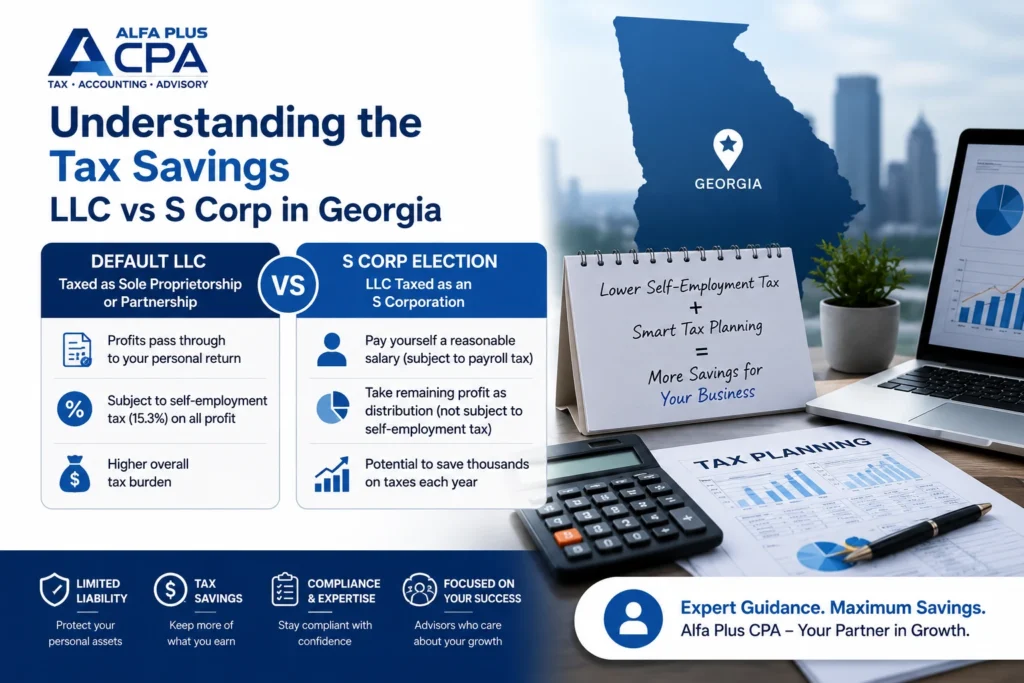
By default, a single-member LLC is taxed as a sole proprietorship and a multi-member LLC is taxed as a partnership. In both cases the business itself pays no federal income tax. The profit passes through to your personal return, and you pay income tax on it.
Here is the part that hurts: all of that profit is also subject to self-employment tax at 15.3%, which covers Social Security and Medicare. If your LLC nets $120,000, you pay self-employment tax on essentially the whole amount on top of regular income tax. For a profitable business, that self-employment tax becomes the single biggest reason owners look at the S corp election.
How the S corp election changes your taxes
When your LLC elects S corp status, you become both an owner and an employee of your own company. That splits your income into two buckets:
- A reasonable salary you pay yourself, which is subject to payroll taxes just like any employee
- The remaining profit, taken as a distribution, which is not subject to self-employment tax
That second bucket is where the savings live. The distribution still gets hit with income tax, but it skips the 15.3% self-employment tax. The catch, and the IRS is strict about this, is that your salary has to be reasonable for the work you do. You cannot pay yourself $10,000 and call the other $110,000 a distribution. Set the salary too low and you invite an audit. The rules are laid out on the IRS S corporation page.
A simple example of the savings:
Say your Georgia business nets $120,000 in profit.
As a default LLC: you pay self-employment tax on roughly the full $120,000. At 15.3%, that is close to $18,000 before income tax even enters the picture.
As an S corp: you pay yourself a reasonable salary of, say, $70,000. Payroll taxes apply to that $70,000, which comes to about $10,700. The remaining $50,000 distribution avoids the 15.3% tax. That difference can mean several thousand dollars in savings in a single year.
The exact numbers depend on your salary level, your total income, and your deductions, so treat this as an illustration rather than a promise. A CPA runs your real figures before you decide. This is exactly the kind of analysis we handle during tax planning.
The costs and extra work of an S corp:
The savings are real, but so is the added work. An S corp is not free money, and for a smaller business the extra cost can wipe out the benefit. Here is what changes:
- Payroll. You have to run formal payroll for your salary, file payroll tax returns, and issue yourself a W-2. Most owners use a payroll service to stay compliant.
- A separate tax return. The S corp files its own return, Form 1120-S, in addition to your personal return.
- More bookkeeping. Clean books are no longer optional. You need accurate records to support your salary, distributions, and expenses.
- Reasonable compensation. You have to justify your salary, which sometimes means documenting comparable pay for your role.
Between payroll processing, the extra return, and accounting, an S corp usually adds a few thousand dollars a year in administrative cost. That is why the math only works once your profit is high enough for the tax savings to clearly beat the added expense. Keeping tidy records through professional bookkeeping is what makes the S corp model run smoothly.
What this looks like in Georgia specifically:
Georgia recognizes the federal S corp election, so a business taxed as an S corp federally is generally treated the same way for state purposes. Georgia has a flat individual income tax, and for 2026 the rate is 4.99% under recent state legislation. Because the rate has changed in recent years, confirm the current figure with the Georgia Department of Revenue before running your own numbers.
Georgia also has an annual registration requirement for LLCs and corporations filed with the Secretary of State, along with a small fee. Whichever tax path you choose, you still keep the entity in good standing with the state. If you would rather not track those filings yourself, a registered agent service can handle the state notices for you. For broader planning questions, the SBA guide to choosing a business structure is a solid neutral starting point.
How to know when to make the switch:
There is no single magic number, but a common rule of thumb is that the S corp election starts to make sense once your business consistently nets somewhere around $60,000 to $80,000 or more in profit after paying yourself a fair salary. Below that, the payroll and filing costs often eat the savings.
A few signs it may be time to look at the election:
- Your profit is steady and growing, not a one-time spike
- You are paying a large self-employment tax bill each year
- You can comfortably support running payroll and a second tax return
- You plan to stay in business for the long haul, not wind down soon
The decision is worth revisiting every year, because a structure that made sense at $40,000 in profit may be costing you money at $150,000.
How to elect S corp status:
If the numbers point toward an S corp, the mechanics are manageable. You keep your Georgia LLC and file Form 2553 with the IRS to elect S corp taxation. There are deadlines that matter. To have the election apply for the current tax year, you generally need to file within two months and fifteen days of the start of that year, though late-election relief exists in some cases.
If you are forming a new business and already know you want this treatment, you can set it up from the start. Our S corporation formation service handles the election, and if the plan involves converting an existing LLC, we make sure the timing and paperwork line up so you do not miss a year of savings.
Make the choice with real numbers:
LLC versus S corp is not about which one is better in general. It is about which one fits your income, your appetite for paperwork, and your plans for the business. For a newer or smaller operation, a simple LLC keeps life easy. For a profitable one, the S corp election can save real money as long as you run payroll and keep clean books.
The only way to know for sure is to run your actual numbers. Alfa Plus CPA helps business owners across Atlanta, Alpharetta, and Georgia compare both paths and choose with confidence. Book a free consultation and we will show you what each option looks like for your business.
Frequently asked questions:
Is an S corp better than an LLC in Georgia?
Neither is better in every case. An LLC is simpler and cheaper to run, while an S corp election can lower self-employment tax once your profit is high enough to outweigh the added payroll and filing costs. The right answer depends on your income and how much administrative work you can handle.
How much money do I need to make before an S corp is worth it?
Many owners find the S corp election starts paying off once the business nets roughly $60,000 to $80,000 or more in profit after a reasonable salary. Below that range, the extra payroll and tax-return costs often cancel out the savings. A CPA can run your specific numbers to find your break-even point.
Can I keep my Georgia LLC and still be taxed as an S corp?
Yes. That is the usual approach. You keep the LLC as your legal structure and file Form 2553 with the IRS to be taxed as an S corp. You keep the liability protection of the LLC and gain the tax treatment of an S corp.
What is reasonable compensation for an S corp owner?
Reasonable compensation is the salary a similar business would pay someone to do the work you do. The IRS expects it to reflect your role, experience, and industry. Setting it too low to avoid payroll tax is a common audit trigger, so it is worth documenting how you arrived at the figure.
Do I have to run payroll if I elect S corp status?
Yes. As an S corp owner you are treated as an employee and must pay yourself a salary through formal payroll, complete with payroll tax filings and a W-2. Most owners use a payroll service or a CPA to keep this accurate and on schedule.