
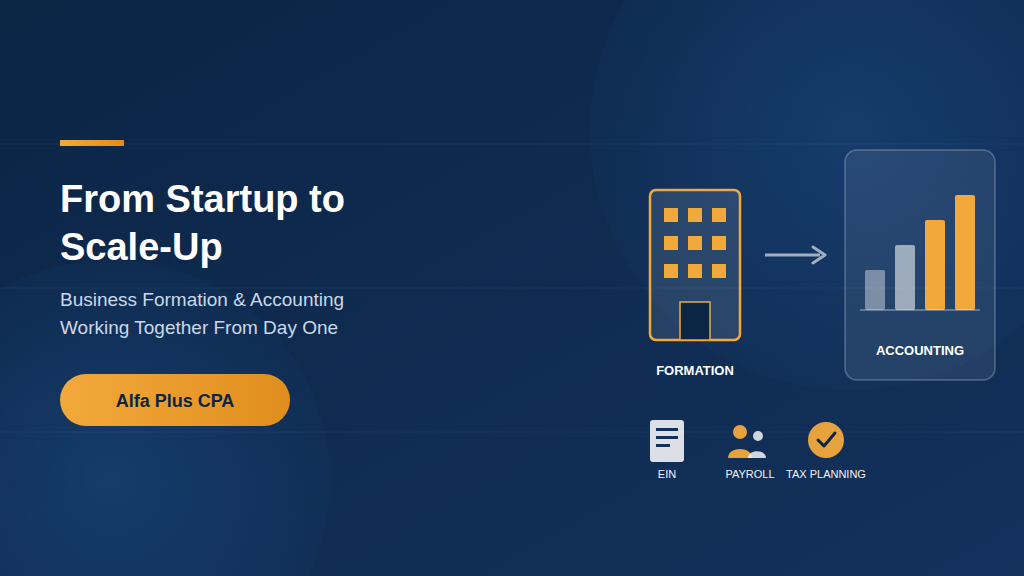
Most entrepreneurs treat business formation and accounting as two separate to-do list items — file the paperwork to legally create the business, then figure out the bookkeeping later. But in practice, these two pieces are deeply connected, and handling them separately often creates problems that surface months or even years down the road: mismatched entity structures, disorganized books from day one, or tax elections that no longer make sense once the business starts generating real revenue.
At Alfa Plus CPA, we combine business formation and small business accounting under one roof specifically because they work better together. Here’s why pairing these two services from the start sets your business up for long-term financial health — not just legal compliance.
The Problem With Treating Formation and Accounting Separately
When a new business owner forms their company through one provider (often an online legal service) and then hires a separate bookkeeper or accountant months later, a few common issues tend to show up:
- The entity structure doesn’t match the tax strategy. An LLC formed without guidance may miss opportunities like an S-corp election that could reduce self-employment tax once the business becomes profitable.
- Books start disorganized from day one. Startup expenses, initial capital contributions, and early transactions often get recorded incorrectly — or not at all — before a bookkeeper is even in the picture.
- Compliance details fall through the cracks. Registered agent requirements, EIN applications, and state filing deadlines are easy to overlook without a team tracking them alongside your financial calendar.
- Nobody has the full picture. Your formation provider doesn’t know your financials, and your accountant doesn’t know how your entity was structured — so nobody can advise you holistically.
How Business Formation Sets the Foundation for Accounting
The decisions made during formation directly shape how your accounting will work going forward. A few examples:
Entity Type Determines Your Tax and Bookkeeping Structure
Whether you form an LLC, an S-corporation, or a C-corporation affects how income is taxed, how owner compensation is handled, and what kind of bookkeeping structure is required. For example, an S-corp requires payroll for owner-employees — something that needs to be set up correctly from the start, not added as an afterthought.
Your EIN Connects Everything Financial
An EIN isn’t just a formality — it’s the identifier tied to your business bank account, payroll system, and tax filings. Getting it set up correctly and promptly avoids delays in opening accounts or running payroll later.
Registered Agent and Compliance Filings Affect Your Financial Calendar
Missing a registered agent notice or annual state filing can result in penalties or administrative dissolution — which, beyond the legal headache, creates accounting complications if your business entity status changes mid-year.
How Early Accounting Setup Prevents Costly Cleanup Later
Just as formation decisions affect accounting, the way your books are set up from day one affects everything that follows — including taxes, financing, and even how smoothly your business can be sold in the future.
Common mistakes we see in businesses that delay proper accounting setup:
- Mixing personal and business expenses in the same bank account
- Failing to track startup costs, which may be deductible over time
- No system in place to track owner contributions or distributions
- Missed opportunities to structure payroll correctly for tax efficiency
- Disorganized records that make the first tax filing far more stressful than it needs to be
Our accounting services are designed to plug directly into a newly formed business, establishing GAAP-compliant bookkeeping, a dedicated accountant, and proper financial statement preparation right from the start — rather than reconstructing a year of messy records after the fact.
The Advantage of a Single, Coordinated Team
When formation and accounting are handled by the same firm, a few things become significantly easier:
- Entity decisions are made with tax strategy in mind, not in isolation
- Bookkeeping starts clean, aligned with how the entity is actually structured
- Deadlines are tracked together — state compliance filings, payroll setup, and tax deadlines all live on one radar instead of being scattered across vendors
- Advice is holistic, because your CPA already understands your entity structure, ownership setup, and financial history
- Scaling is smoother, since payroll, CFO-level guidance, and tax planning can be layered in as the business grows, without starting from scratch with a new provider
A Typical Client Journey: Formation to Full Financial Support
Many of our clients follow a natural progression as their business grows:
- Formation — choosing the right entity type, filing paperwork, securing an EIN, and setting up a registered agent
- Foundational Accounting — establishing bookkeeping systems, a business bank account, and basic financial tracking
- Payroll Setup — bringing on employees or formalizing owner compensation through our payroll services
- Ongoing Tax Planning — shifting from reactive tax filing to proactive tax planning as profitability increases
- Strategic Growth Support — layering in part-time CFO services as financial decisions become more complex
Because we support each of these stages, clients don’t need to search for a new provider every time their business reaches the next milestone.
Who Benefits Most From Combined Formation and Accounting Support
- First-time entrepreneurs who don’t yet know what they don’t know about entity structuring or bookkeeping
- International founders setting up a U.S. business presence for the first time
- Side businesses transitioning to full-time that need to formalize both their legal structure and their finances
- Existing businesses restructuring — converting from a sole proprietorship to an LLC or S-corp, for example — who need both legal and accounting continuity during the transition
Start Strong, Stay Organized
The businesses that scale most smoothly are usually the ones that got the foundation right from day one — a properly structured entity paired with clean, consistent bookkeeping. Handling formation and accounting through one coordinated team eliminates the gaps that so often show up when these functions are split between disconnected providers.
Starting a business or restructuring an existing one? Schedule a free consultation with Alfa Plus CPA today, and let our team build your formation and accounting foundation the right way — together, from the very beginning.