
The Hidden Danger in Payroll Taxes
Running payroll feels routine — until it isn’t.
Most small business owners in Atlanta and Alpharetta set up payroll early on, get the deposits running, and largely stop thinking about it. That’s understandable. Payroll is one of those things that fades into the background when it’s working. The problem is that the IRS doesn’t grade on a curve when it isn’t.
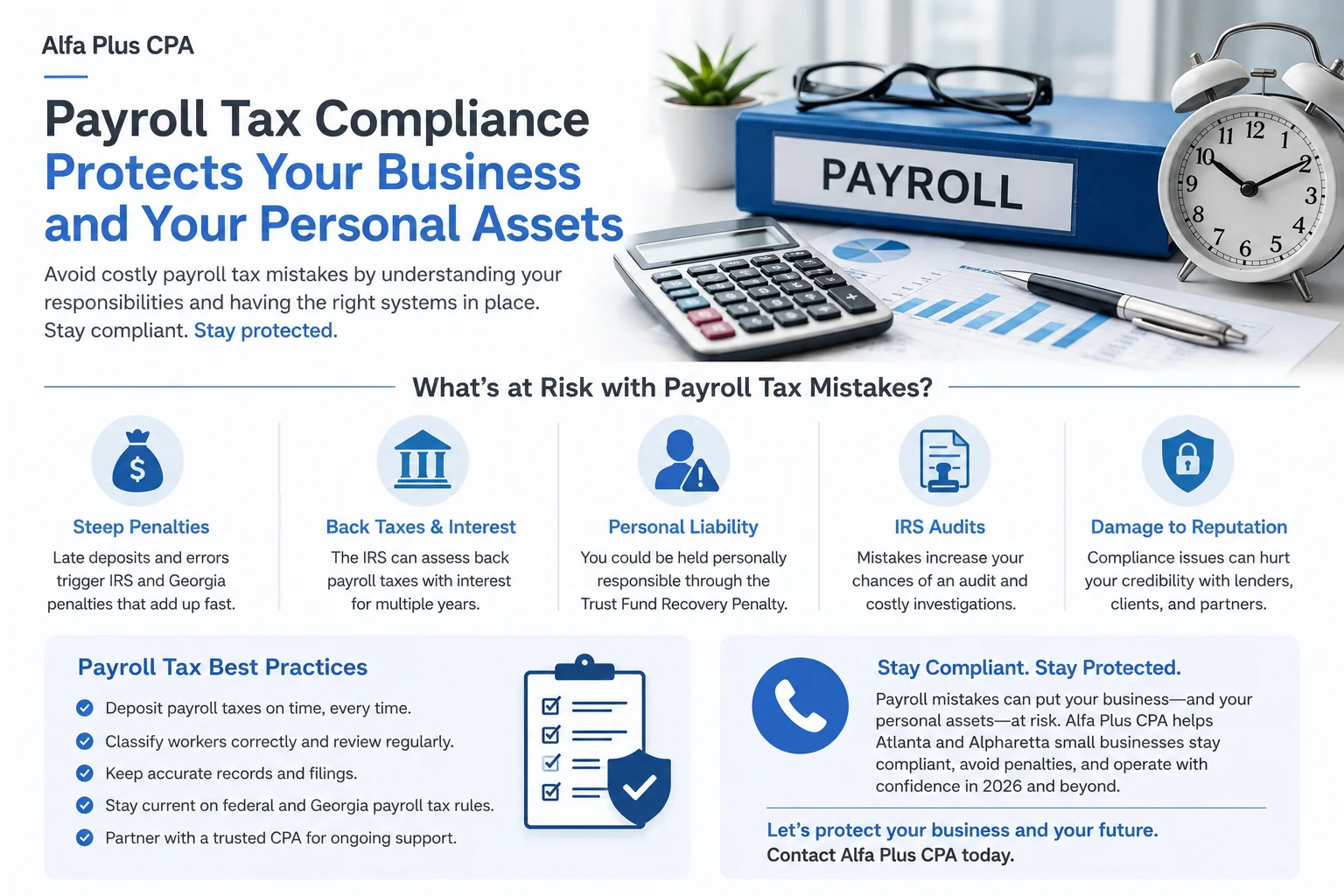
Payroll tax mistakes are consistently among the most expensive errors small businesses make. They trigger penalties that compound quickly, and in serious cases, they can result in the IRS pursuing business owners personally — not just the company. That distinction matters, because it means your personal bank accounts, assets, and financial future can be at stake.
This guide covers the most common payroll mistakes Georgia business owners make in 2026, what the consequences look like, and how to avoid them.
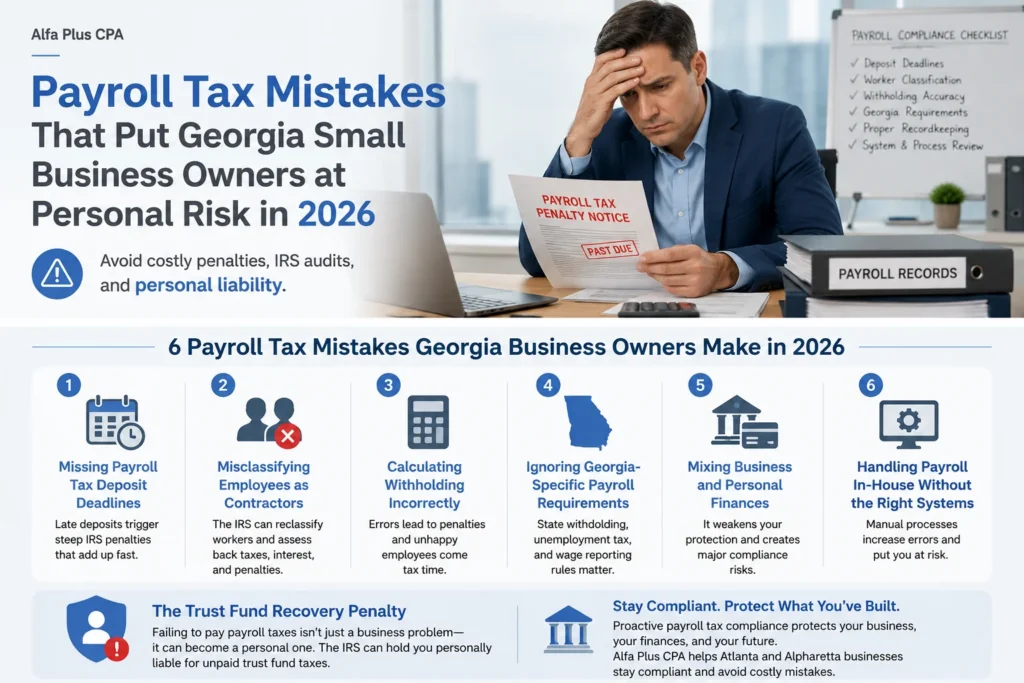
Mistake #1: Missing Payroll Tax Deposit Deadlines
When you pay employees, you withhold federal income tax, Social Security, and Medicare taxes from their wages. You’re also required to deposit those withheld amounts with the IRS on a specific schedule — either monthly or semi-weekly, depending on your total payroll tax liability in a prior lookback period.
Missing a deposit deadline triggers an immediate IRS penalty:
- 2% if the deposit is 1–5 days late
- 5% if 6–15 days late
- 10% if more than 15 days late
- 15% if the IRS issues a notice and the deposit is still not made
These percentages apply to the amount of the missed deposit, not your total tax bill. If you run weekly payroll and miss a deposit worth $5,000, you’re looking at $500 in penalties on that single event alone.
In 2026, the IRS has accelerated automated enforcement. Businesses that miss a deposit receive a Notice of Underpayment faster than in previous years — sometimes within weeks of the missed date.
The fix is straightforward: set up automatic payroll tax deposits through the IRS Electronic Federal Tax Payment System (EFTPS) and make sure someone in your business confirms each deposit was submitted. Automating the process removes human error from the equation.
Mistake #2: Misclassifying Employees as Independent Contractors
This is one of the most common — and costly — payroll mistakes in small businesses.
The distinction matters because employers pay payroll taxes for employees (half of Social Security and Medicare) but not for independent contractors. Some business owners, intentionally or not, classify workers as contractors when the working relationship actually meets the IRS definition of an employment relationship.
The IRS looks at factors like:
- Behavioral control (does the business control how the work is done?)
- Financial control (is the worker economically dependent on one business?)
- Type of relationship (is the work central to the business? Are there written contracts, benefits, ongoing relationships?)
If the IRS reclassifies your contractors as employees, you can owe back payroll taxes, plus interest and penalties going back multiple years. Georgia’s Department of Revenue can also audit for the same issue on the state side.
The safest approach: any time you bring on a worker who functions like an employee — same hours, same tasks, same workspace, regular relationship — get a CPA’s review before you classify them.
Mistake #3: Calculating Withholding Incorrectly
Federal income tax withholding depends on each employee’s W-4, their pay frequency, and the applicable IRS tax tables. It changes when employees update their W-4s, when pay rates change, and when Congress updates withholding tables. Georgia has its own separate withholding requirements on top of federal.
Common withholding errors include:
- Using outdated IRS or Georgia withholding tables
- Not updating withholding when employees submit new W-4s
- Miscalculating withholding for employees with multiple jobs, supplemental income, or non-standard deductions
- Failing to apply Georgia’s withholding correctly for employees who live in Georgia but work remotely in another state, or vice versa
Withholding errors affect employees too. If you over-withhold, employees get a larger refund but lose access to that money during the year. If you under-withhold, employees face a tax bill in April — and potentially blame their employer.
Review your payroll calculations at least annually, and any time the IRS or Georgia Department of Revenue releases updated withholding tables.
Mistake #4: Ignoring Georgia-Specific Payroll Requirements
Federal payroll compliance is table stakes. Georgia adds its own layer of requirements that businesses operating in Atlanta, Alpharetta, or anywhere else in the state need to follow.
Key Georgia-specific payroll obligations include:
State income tax withholding. Georgia requires employers to withhold state income tax from employee wages. Deposits must be made to the Georgia Department of Revenue, separately from federal deposits.
New hire reporting. Georgia law requires employers to report newly hired and rehired employees to the Georgia New Hire Reporting Center within 10 days of their start date. Failing to report timely can result in fines.
Georgia unemployment insurance (UI) tax. Employers pay state unemployment tax (SUTA) to the Georgia Department of Labor. The rate varies based on your industry and claims history. New employers pay a standard rate until their claims history is established.
Workers’ compensation. Most Georgia businesses with three or more employees are required to carry workers’ compensation insurance. Operating without it exposes you to significant legal and financial liability.
Many Atlanta-area businesses inadvertently fall out of compliance on one or more of these requirements — especially fast-growing companies that hire quickly and don’t have payroll systems that automatically flag state-level obligations.
Mistake #5: Mixing Business and Personal Finances
This one isn’t technically a payroll mistake, but it creates payroll problems. When business and personal funds run through the same accounts, bookkeeping becomes guesswork. Guesswork in bookkeeping leads to errors in payroll calculations, misclassified expenses, and difficulty preparing accurate payroll tax filings.
The IRS also looks unfavorably on commingled finances during audits. If your business records can’t clearly distinguish business transactions from personal ones, it raises questions about the integrity of your filings more broadly.
The solution is simple and non-negotiable: separate bank account for the business, separate credit card for business expenses, and consistent bookkeeping that tracks both. Alfa Plus CPA’s bookkeeping services (https://alfapluscpa.com/services) can help you establish clean financial records from the ground up.
Mistake #6: Handling Payroll In-House Without the Right Systems
Small business owners often start handling payroll manually or with basic spreadsheet systems. For a company with two or three employees, this sometimes works. As the business grows and the payroll gets more complex — more employees, different pay rates, benefits deductions, garnishments, multi-state employees — the margin for error grows too.
The most common in-house payroll pitfalls:
- Missing deposit deadlines because no one tracked them
- Failing to update payroll calculations when tax tables change
- Incorrect overtime calculations for non-exempt employees
- Payroll records that don’t meet IRS recordkeeping requirements (you’re required to retain payroll records for at least four years)
If you’re running payroll in-house and you’re not 100% confident it’s accurate, that’s the right time to bring in professional help. The cost of outsourcing payroll is almost always less than the cost of a single penalty event.
The Trust Fund Recovery Penalty — What Every Business Owner Should Know
This is the part of payroll compliance that surprises business owners the most.
When you withhold federal income tax, Social Security, and Medicare from employee wages, that money is being held in trust for the U.S. government. You collected it on the government’s behalf. If your business fails to remit those withheld taxes to the IRS, the government doesn’t just pursue your company — it can come after you personally.
Under Internal Revenue Code Section 6672, the IRS can assess the Trust Fund Recovery Penalty (TFRP) against any person in the business who was responsible for collecting and remitting payroll taxes and willfully failed to do so. “Willful” doesn’t require intent to defraud — it means you knew about the obligation and chose not to pay.
The TFRP equals 100% of the unpaid trust fund taxes. If your business failed to remit $75,000 in withheld employee taxes, the IRS can assess $75,000 personally against you, your business partner, your CFO, or anyone else they determine was responsible.
In 2026, IRS enforcement of the TFRP is more aggressive than in prior years. The agency has expanded its automated systems for detecting missed payroll tax deposits and has increased personal assessments against business owners.
If you’re behind on payroll taxes, the worst thing you can do is ignore it. Contact Alfa Plus CPA (https://alfapluscpa.com/contact) to understand your options for resolving past-due payroll obligations before the IRS escalates.
How Alfa Plus CPA Helps Atlanta and Alpharetta Businesses Stay Compliant
Payroll compliance isn’t something most business owners want to think about every week. That’s exactly why professional payroll services exist.
At Alfa Plus CPA (https://alfapluscpa.com), we handle payroll processing for small businesses throughout Atlanta, Alpharetta, Roswell, Sandy Springs, and the greater Georgia area. Our payroll services include:
- Accurate payroll processing for hourly and salaried employees
- Federal and Georgia payroll tax calculations and deposits
- Quarterly payroll tax filings (Form 941, Georgia G-7)
- W-2 and 1099 preparation at year-end
- New hire reporting
- Workers’ compensation reporting support
- Payroll records maintenance
We also work alongside your bookkeeping and tax planning, so everything stays coordinated. When your books are clean and your payroll is current, your annual tax filing is straightforward — not a scramble.
If you’re currently handling payroll in-house and aren’t confident everything is right, a payroll review is a low-cost way to find out. Schedule a consultation with Alfa Plus CPA (https://alfapluscpa.com/contact) to discuss your payroll situation — no obligation, no pressure.
FAQs About Payroll Compliance in Georgia
- How often do I need to deposit federal payroll taxes?
It depends on your total payroll tax liability. Businesses that owed $50,000 or less in payroll taxes in the prior lookback period deposit monthly. Businesses that owed more than $50,000 deposit semi-weekly. New businesses generally start on a monthly schedule. The IRS notifies you each November which schedule applies for the following year.
- What happens if I misclassify an employee as an independent contractor in Georgia?
If the IRS reclassifies the worker as an employee, you can owe the employer’s share of payroll taxes that should have been paid, plus interest and penalties going back to when the misclassification began. Georgia’s Department of Revenue may assess additional state taxes. The total liability can be substantial for long-term misclassifications.
- Can the IRS really come after me personally for unpaid payroll taxes?
Yes. The Trust Fund Recovery Penalty under IRC Section 6672 allows the IRS to assess unpaid trust fund taxes personally against any “responsible person” who willfully failed to remit them. This includes business owners, partners, and officers. The personal assessment equals 100% of the unpaid withholding — not a percentage of it.
- What records am I required to keep for payroll in Georgia?
The IRS requires payroll records to be kept for at least four years. These include employee W-4 forms, wage and hour records, payroll tax filings, records of tax deposits made, and year-end W-2 and 1099 forms. Georgia may require additional records for state compliance purposes.
- Is it more cost-effective to handle payroll in-house or outsource it to a CPA?
For most small businesses with five or more employees, professional payroll services are typically cost-effective when you factor in the time spent, software costs, and the risk of errors. A single missed deposit penalty or payroll tax audit can cost far more than a year of professional payroll service fees. For businesses with 10 or more employees, in-house payroll almost always costs more when all factors are considered.
Alfa Plus CPA serves small business owners, entrepreneurs, and individuals throughout Atlanta, Alpharetta, Roswell, Sandy Springs, and the greater Georgia area. Our services include tax planning, accounting, bookkeeping, payroll, and business advisory. Contact us at https://alfapluscpa.com/contact to schedule a consultation.
External sources referenced:
- IRS — Payroll Taxes: https://www.irs.gov/businesses/small-businesses-self-employed/payroll-taxes
- IRS — Trust Fund Recovery Penalty: https://www.irs.gov/businesses/small-businesses-self-employed/employment-tax-evasion-schemes
- Georgia Department of Revenue — Withholding Tax: https://dor.georgia.gov/taxes/business-taxes/withholding-tax
- Georgia Department of Labor — Employer Information: https://dol.georgia.gov/employers/new-hire-reporting
- IRS — Independent Contractor vs. Employee: https://www.irs.gov/businesses/small-businesses-self-employed/independent-contractor-defined