
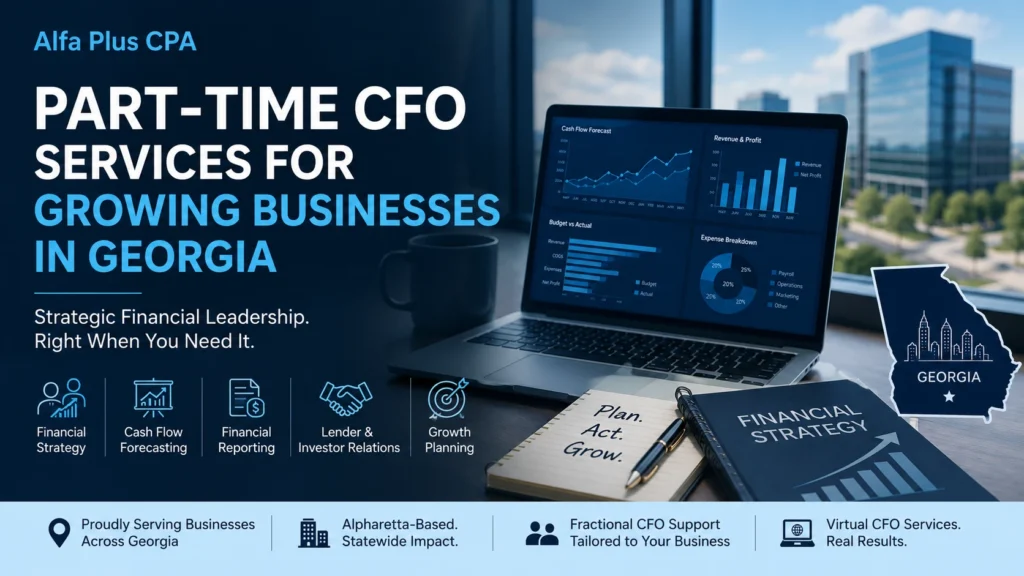
As businesses across Georgia continue to grow, managing cash flow, forecasting, and financial strategy becomes more complex than basic bookkeeping alone. That’s where professional Alfa Plus CPA can help through reliable Part-Time CFO Services designed for scaling companies. A part-time CFO gives growing businesses access to high-level financial guidance without the cost of hiring a full-time executive. In this guide, we’ll explain when your business needs Part-Time CFO Services and what you can realistically expect from working with one.
Most small business owners know they need accounting. They hire a bookkeeper, get an accountant for tax season, and feel covered.
Then the business starts growing. Revenue climbs past $700,000. They take on their first investor. They’re looking at a commercial line of credit. Suddenly they’re in financial conversations they’ve never had before – cash flow forecasting, debt structuring, growth modeling – and their bookkeeper genuinely cannot help with any of it.
That gap has a name. And a solution.
A part-time CFO is not a full-time hire. Not a one-time advisor. It’s a real, ongoing financial strategist who shows up in your business on a retained basis – without the $200,000 salary you’d pay a traditional Chief Financial Officer.
This is what Alfa Plus CPA’s part-time CFO service delivers. Here’s how it works, who needs it, and what it costs.
The Financial Gap That’s Quietly Slowing Your Growth
There’s a well-documented problem in small business finance.
Businesses under $1M in revenue typically get by with a bookkeeper and a tax accountant. Businesses with $10M or more usually have full-time financial leadership. But the businesses in the middle – the $750,000 to $7M range – often fall through the cracks.
They’re too big to run on gut instinct and spreadsheets. They’re too small to justify a full-time CFO salary. And most of them don’t know the middle option exists.
The U.S. Small Business Administration identifies inadequate financial management as one of the leading causes of small business failure during the growth phase. Not a bad product. Not a lack of customers. The financial infrastructure simply failed to keep up with the business.
A part-time CFO is that infrastructure. Brought in on your terms, at a cost that works for your stage of growth.
What a Part-Time CFO Actually Does (Not What You Think)
A Chief Financial Officer is responsible for the overall financial health and direction of a business. They’re not doing bookkeeping – that’s a separate function. They’re not filing tax returns – that’s your accountant. A CFO sits above both of those functions and connects financial data to business decisions.
In practice, a part-time CFO for a Georgia small or mid-sized business handles:
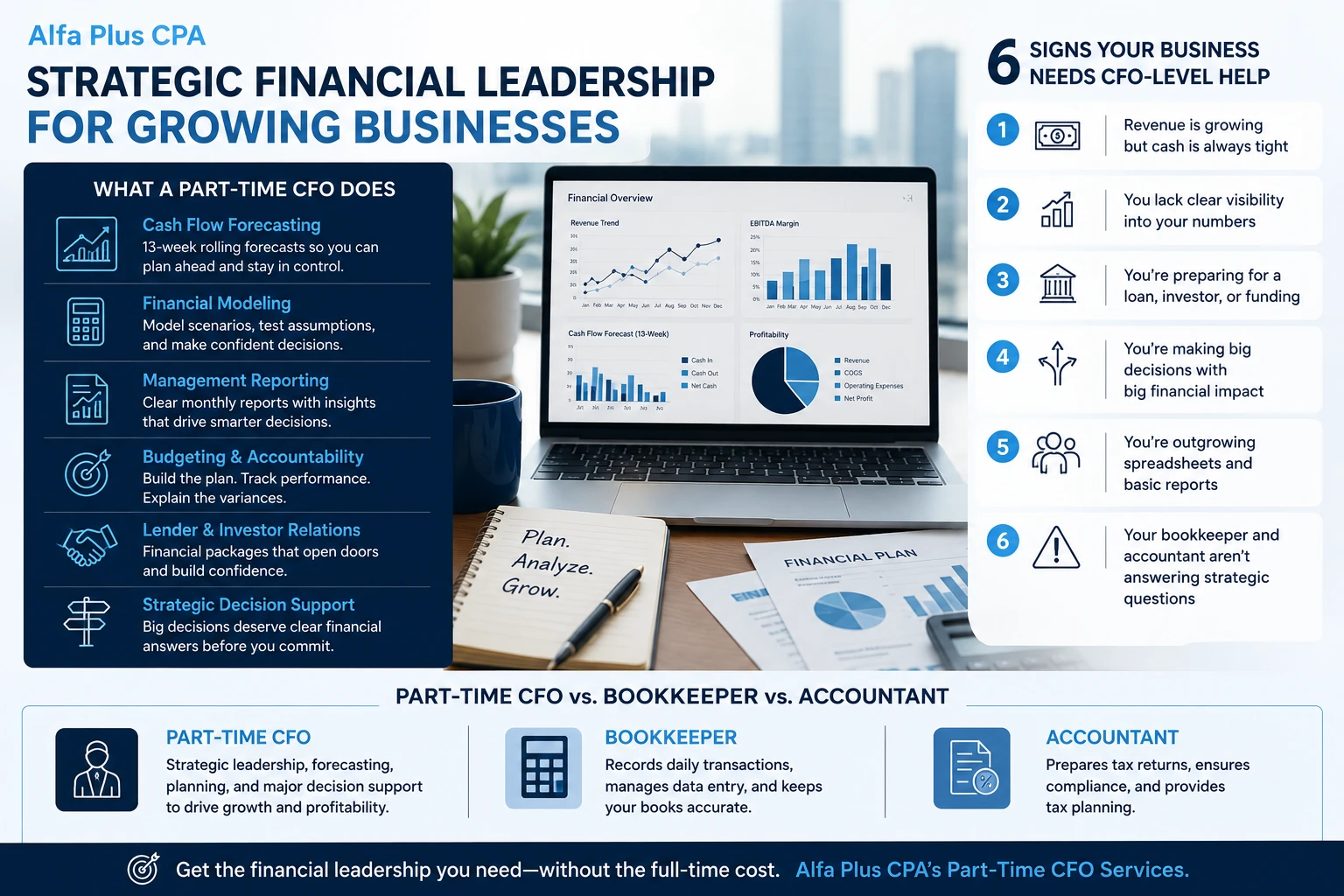
- Cash flow forecasting. Not just “do we have money in the account” but 13-week rolling forecasts that show exactly when cash gets tight, so you can act in advance rather than react in a panic.
- Financial modeling. What happens to your margins if you hire three more people? What if your biggest client cuts their contract by 30%? What’s the break-even on that new location? These are CFO questions, and they require models built on your actual numbers.
- Management reporting. Monthly financial packages with real analysis – not just P&L statements, but commentary on what the numbers mean and what decisions they point to.
- Budget creation and accountability. Building the annual budget with your leadership team and tracking performance against it every month, with variance analysis that explains what changed and why.
- Lender and investor relations. If you’re applying for an SBA loan, a commercial line of credit, or talking to investors, a CFO prepares the financial package lenders expect and often joins those conversations directly.
- Major business decision support. Acquisitions, lease negotiations, new service lines, hiring plans – a CFO models the financial impact before you commit.
The part-time version does all of this. Typically on a retained basis for 8 to 20 hours per month, depending on business complexity and growth stage.
Six Signs Your Business Needs CFO-Level Help Right Now
You may not need a full-time CFO. But you might need a part-time one. Here are the situations that consistently signal it’s time for that conversation.
- Your revenue is growing but cash is always tight. You’re profitable on paper but constantly running short on operating cash. This is almost always a working capital, receivables, or payroll timing issue that a CFO can diagnose in the first month of engagement.
- You’re planning to raise capital or take on significant debt. Investors and SBA lenders ask CFO-level questions. Bringing professional financial leadership into those conversations changes how your business is perceived and usually improves the terms you’re offered.
- Your books are accurate but you have no idea what they mean for next year. Bookkeepers and accountants produce retrospective reports. A CFO translates those reports into forward-looking decisions.
- You’re thinking about selling in the next 3 to 5 years. Getting your financials into buyer-ready shape takes time – typically 18 to 36 months. A CFO starts that process early enough to actually improve your valuation.
- You’re about to make a major hiring or operational commitment. These decisions have long-term margin implications that need to be modeled before you’re locked in. This is exactly the work a part-time CFO does.
- You’re paying taxes reactively and don’t really understand your tax position until April. If this sounds familiar, the issue isn’t just your accountant – it’s that nobody is connecting your operational decisions to your tax strategy throughout the year. Our Tax Planning team handles the compliance and strategy side; a part-time CFO makes sure your business decisions align with it.
Part-Time CFO vs. Bookkeeper vs. Accountant: The Real Difference
This distinction is worth spelling out clearly because many business owners conflate these roles.
A bookkeeper records what already happened. They code transactions, reconcile bank accounts, and keep your records accurate and organized. This is essential work. It is not strategic work.
An accountant handles compliance. Tax filings, financial statement preparation, audit support. A good CPA also provides valuable guidance on specific decisions. But their core job is accuracy and compliance with current obligations.
A CFO uses what the bookkeeper and accountant produce and asks: what does this mean for the business? They sit above the transactional layer entirely and connect financial data to business decisions – hiring, pricing, capital structure, risk management.
At Alfa Plus CPA, our Accounting and Bookkeeping services and Payroll services build the foundation. CFO services sit on top of that foundation to provide strategic direction.
The combination – accurate books, clean compliance, forward-looking strategy – is what financial maturity actually looks like in a growing business. Most small businesses have the first two and are missing the third.
What Alfa Plus CPA’s CFO Services Cover
Our Part-Time CFO service is built for businesses that need financial leadership without the overhead of a full-time hire.
We work with clients on a monthly retainer basis. Depending on your business size and the complexity of what you’re working through, that might mean weekly involvement during a financing process or monthly reporting sessions during a steadier period.
A typical Alfa Plus CPA CFO engagement includes:
- Monthly financial reporting packages with management commentary. Not just the numbers – an explanation of what the numbers mean and what they suggest you do next.
- 13-week cash flow forecasting for businesses that need tight cash management, and longer horizon models (12 to 36 months) for strategic planning.
- Annual budget development with your leadership team, followed by monthly variance analysis tracking actual performance against plan.
- KPI dashboard design and monitoring. We identify the financial metrics that matter most to your specific business model and make sure you’re tracking them consistently every reporting period.
- Financial modeling for major decisions. Whether you’re evaluating a new hire, a facility commitment, a service line expansion, or an acquisition, we model the financial impact before you commit resources.
- Banking and investor relations support. We prepare the financial packages lenders and investors request and join calls to answer financial questions directly and credibly.
- Tax strategy coordination. We align the CFO strategy with your tax planning so you’re not optimizing one side at the expense of the other.
For businesses that need strategic financial guidance on a project basis rather than an ongoing retainer, we also offer Financial Consultancy services that can be scoped to specific decisions or transactions.
What Does a Part-Time CFO Actually Cost?
This is the first question most business owners ask. It’s also the right one.
Full-time CFO salaries in Georgia range from $150,000 to $250,000 per year, plus benefits, bonuses, and employment overhead. For a business under $5M in revenue, that’s a significant commitment for a role that may not require 40 hours per week of work.
Part-time CFO services typically run between $2,500 and $8,000 per month depending on business size and level of involvement required. For a business doing $1.5M to $5M in revenue, the typical range is $3,000 to $5,000 per month.
That works out to $36,000 to $60,000 per year – a fraction of a full-time hire, with no employment overhead, no benefits cost, and no long-term commitment if your needs change.
The more useful comparison isn’t part-time CFO cost vs. full-time CFO salary. It’s the cost of CFO services vs. the cost of major decisions made without financial leadership.
A single poorly structured financing deal. One acquisition that looked right on gut instinct and fell apart in the numbers. A year of reactive tax payments that a proactive CFO would have cut by 20%. These situations cost multiples of what a part-time CFO engagement runs for an entire year.
The SBA notes that financial mismanagement is among the leading causes of small business failure. The math on preventing it tends to be straightforward.
The Real Price of Running Your Business Without a CFO
No CFO doesn’t mean no financial risk. It means financial risk with nobody watching for it.
Here’s what consistently happens to growing businesses that outpace their financial infrastructure:
- Persistent cash flow surprises. Revenue looks healthy but the business is always short on operating cash because nobody is actively managing the timing of receivables, payables, and payroll against actual cash position.
- Margin erosion that happens too slowly to notice. Labor costs creep up. Vendor pricing adjusts. Overhead grows with headcount. Nobody tracks it against revenue at a detailed enough level to catch the drift until margins are 5 to 8 points lower than they were three years ago.
- Over-reliance on debt. Without cash flow models, business owners take on more credit than their operating cash flow can sustainably service, especially during a revenue dip.
- A missed or undervalued exit. When a buyer or investor approaches, the business financials aren’t organized, clean, or presented in a way that supports a strong valuation. Deals fall apart or close well below what the business was actually worth.
- Tax planning that’s done in a rush at year-end instead of throughout the year. The business pays significantly more in taxes than necessary because planning only happens in the six weeks before filing.
SCORE, the nonprofit mentoring organization supported by the SBA, consistently identifies financial management as a top factor in business survival and growth. That finding has held across decades of data from thousands of small businesses.
A part-time CFO doesn’t guarantee none of these things happen. But it puts someone in your business whose entire job is to see them coming and help you avoid them. That’s a different posture than discovering the problem after the fact.
Frequently Asked Questions About Part-Time CFO Services in Georgia
What is the difference between a part-time CFO and a fractional CFO?
The terms are used interchangeably across the industry. Both refer to a CFO-level professional who works with your business on a part-time, shared, or retained basis rather than as a full-time employee. At Alfa Plus CPA, we work on retainer so you have consistent, predictable access to financial leadership every month.
What revenue level should a business reach before considering a part-time CFO?
Most businesses start thinking seriously about CFO-level support around $750,000 to $1M in annual revenue, especially during a period of rapid growth, when preparing for financing, or when facing complex financial decisions they can’t evaluate internally.
Can a part-time CFO help my business get approved for an SBA loan or bank financing?
Yes, and this is one of the most immediate, high-value services a CFO provides. Banks and SBA lenders require specific financial documentation – historical financials in specific formats, cash flow projections, debt service coverage analysis, and a credible financial narrative. A CFO prepares all of this and often joins financing calls to handle financial questions directly, meaningfully improving both approval odds and the terms offered.
How is the part-time CFO engagement structured at Alfa Plus CPA?
We start with a financial review of your current state – books, reporting, cash flow patterns, and financial goals. From there, we identify the highest-priority gaps and build an engagement plan accordingly. We adjust the engagement to fit where you actually are, not a fixed template.
Does a part-time CFO replace my existing bookkeeper and accountant?
No. A CFO works alongside your existing financial team, not instead of them. If your bookkeeping and accounting are already handled by Alfa Plus CPA, the integration is seamless. If you use another provider for those functions, we coordinate with them directly.
Can a part-time CFO help prepare my business for sale?
This is one of the most valuable things a CFO does for growth-stage businesses thinking about an eventual exit. Preparing a business for sale takes 18 to 36 months of intentional work – cleaning up the books, normalizing financial statements, and building a credible financial narrative that supports your valuation. Businesses that begin exit preparation two to three years out consistently achieve better multiples.
Is there a difference between a part-time CFO and a financial advisor?
Yes – a significant one. A financial advisor typically manages personal investments and individual wealth planning. A CFO manages business finances: cash flow, capital structure, operational margins, financial reporting, growth modeling, and business strategy. A financial advisor helps you manage personal wealth; a CFO helps your business build it in the first place.
Start with a Free Consultation
Running a business without financial leadership is manageable when the business is small. Once you’re growing, it becomes a risk you’re probably underestimating.
The businesses that scale well – and sell well, when the time comes – are almost always the ones that invested in financial infrastructure before they felt like they needed it. Not after problems showed up.
Alfa Plus CPA offers part-time CFO services for growing businesses in Alpharetta and across Georgia. If you’re not sure whether you need CFO-level support or just better bookkeeping and tax planning, that’s exactly what a free consultation is for.
Book a free call with our team or call us at +1 404-507-2396.