
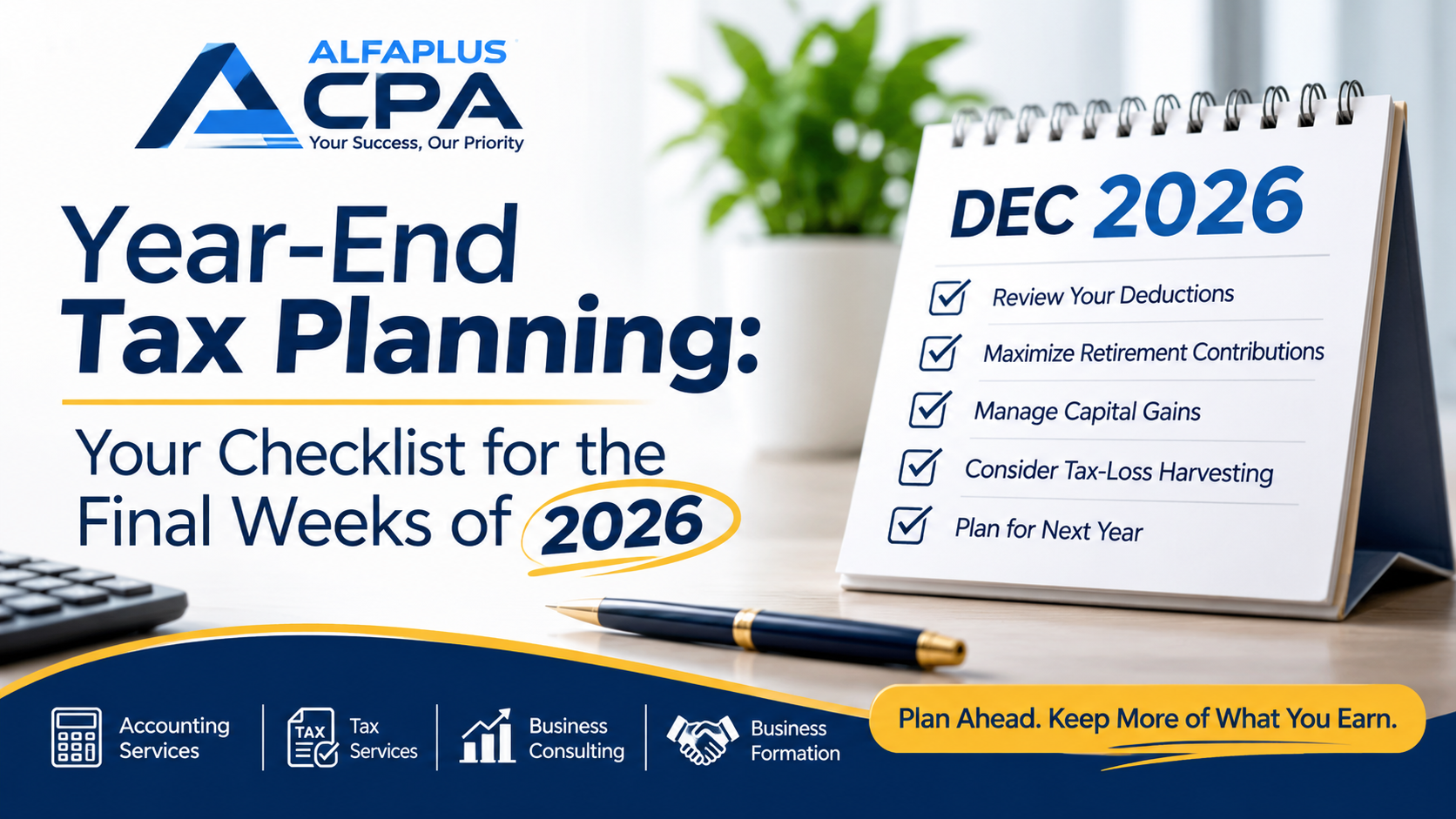
The calendar is running out. With roughly five weeks left in the year, this is the last practical window to lower your 2026 tax bill, clean up your finances, and avoid surprises in January. Many of the best tax moves have a December 31 deadline, and once the year closes, they're gone.
At Alfa Plus CPA, year-end is our busiest planning season, and it's the one service that touches nearly everything we do: tax, accounting, payroll, formation, and international compliance. Here's a practical checklist for individuals and business owners, built so you can act on it this week.
Why Year-End Tax Planning Matters
Tax preparation reports what already happened. Year-end tax planning is your final chance to change what happened. A few well-timed decisions in December can shift income, accelerate deductions, and put you in a stronger position when filing season arrives.
Acting now helps you:
- Reduce your taxable income while there's still time
- Avoid underpayment penalties on estimated taxes
- Spot problems in your records before they become filing problems
- Start January with clean numbers and a clear plan
Step 1: Project Your 2026 Tax Picture
Every good year-end plan starts with an estimate. Before making any moves, look at where you stand:
- Year-to-date income and expenses
- Expected income for the rest of the year
- Estimated taxes paid so far, and any shortfall
- Whether your income is higher or lower than last year
If income is running unusually high, you may want to defer some of it or accelerate deductions. If it's lower, the opposite may make sense. A projection tells you which direction to go. Our tax planning services are built around exactly this kind of mid-to-late-year review.
Step 2: Clean Up Your Financial Records
You can't plan with numbers you don't trust. December is the time to make sure your records are accurate and complete:
- Reconcile all bank and credit card accounts
- Categorize outstanding transactions
- Follow up on unpaid invoices and unrecorded expenses
- Separate any personal expenses that landed in business accounts
- Gather receipts and documentation for larger purchases
If you're behind, catch-up work now is far easier than a scramble in March. Our accounting services include catch-up support so your financial statements are accurate before year-end decisions are made.
Step 3: Time Income and Deductions
For many taxpayers, the core of year-end planning is timing. Common approaches include:
- Deferring income into the new year when appropriate, such as delaying a December invoice for a cash-basis business
- Accelerating deductible expenses into 2026, such as paying a bill or making a purchase before December 31
- Reviewing equipment purchases: assets generally need to be placed in service, not just ordered, by year-end to count for the year
- Prepaying certain expenses where the rules allow
Rules and limits on these strategies vary and change, so confirm what applies to your situation before acting.
Step 4: Maximize Retirement Contributions
Retirement contributions are one of the most accessible ways to lower taxable income. Key points:
- Employee 401(k) deferrals generally need to happen by December 31
- Some other plans and IRA contributions have later deadlines, but waiting can mean missing cash-flow opportunities
- Self-employed owners may have access to plans such as a SEP IRA or Solo 401(k), and some require setup steps that take time
- Required minimum distributions, if you're subject to them, generally must be taken by year-end to avoid penalties
Contribution limits are adjusted periodically, so check the current-year figures before you finalize amounts.
Step 5: Review Your Business Structure and Owner Pay
Year-end is a smart time to ask whether your current setup still fits:
- S-corporation owners: Is your salary reasonable compared with distributions? Payroll adjustments should be completed before year-end.
- LLC and sole proprietors: Has profit grown enough that restructuring could help in the coming year?
- New or growing businesses: Should you formalize your structure? Our business formation services can help you plan changes to take effect early in the new year.
Some elections have deadlines early in the year, so deciding in December leaves time to act.
Step 6: Get Payroll and Worker Classification in Order
Payroll mistakes are costly, and year-end is when they surface. Use December to:
- Confirm that payroll tax deposits are current
- Verify worker classifications for employees and contractors
- Collect missing information from contractors you'll need to report
- Prepare for W-2 and 1099 deadlines, which generally fall in late January
Our payroll services help businesses close out the year accurately.
Step 7: Check Your Sales Tax Exposure
If you sell across state lines, your sales may have crossed a state's economic nexus threshold this year without you noticing. A year-end review can show where you may need to register or file, and it's much better to find out now than when a state notice arrives. Our sales tax services can map your exposure.
Step 8: Don't Forget International Filings
If you have foreign owners, accounts, or companies, year-end is the time to organize records for filings that come due with your return, such as Form 5472, Form 5471, FBAR, and Form 8938, depending on your situation. Missing informational forms can carry heavy penalties even when no tax is owed. Related-party pricing should also be documented. See our international tax services and transfer pricing services.
Step 9: Make Charitable and Estimated Tax Decisions
- Charitable giving: Donations generally must be completed by December 31 to count for 2026, and documentation matters
- Estimated taxes: If you've underpaid during the year, look at how to close the gap and avoid penalties
Step 10: Line Up Your Filing-Season Plan
Once the year ends, filing season follows quickly. Gather prior-year returns, financial statements, payroll reports, and any foreign-account details so preparation is smooth. Our business tax preparation services pick up where year-end planning leaves off, and if a notice ever arrives, IRS representation is available.
A Quick Year-End Checklist
- Estimate 2026 income and tax
- Reconcile and clean up financial records
- Decide what to defer or accelerate
- Complete retirement contributions and required distributions
- Review S-corp salary and entity structure
- Confirm payroll and contractor information
- Review sales tax nexus
- Organize international filing records
- Finalize charitable gifts
- Schedule your filing-season review
Don't Wait Until January
The most valuable planning window closes on December 31. If you'd like a professional to review your numbers and recommend specific moves, now is the time to reach out.
Ready for a year-end tax review? Call +1 678-694-7425 or schedule a free consultation with Alfa Plus CPA, and let's make the most of the weeks that remain.
Frequently asked questions
What should I prepare for a tax consultation?
Bring prior returns, relevant notices and a summary of changes in income, ownership or operations. Ask which documents are needed for your particular filing or planning question.
Does this article replace advice about my circumstances?
No. It provides general information. Discuss your facts, applicable requirements and deadlines with the appropriate professional before acting.
How can I discuss the support I need?
Request a free initial consultation and describe your question. Confirm the scope, timing and fees before an engagement begins.